The first interesting note is that the Astor was apparently not merely “segregated” in the familiar sense of a white theater with a Black balcony. The surviving trade evidence classifies it as a “Negro Theatre” — the contemporary exhibition-industry term for a house serving an African-American audience. Cinema Treasures cites the 1950 Film Daily Year Book listing the Astor specifically in its “Negro Theaters” section. It opened at 511 E. 36th Street on March 1, 1948, had 446 seats, and Film Daily described it shortly afterward as a theater converted from a store building and operated by Colonial Theaters Corporation of Valdese. That building is today’s Neighborhood Theatre.
So there is a fairly extraordinary continuity there: Black movie house under Jim Crow, then the adult-film Astor Art Theatre, then a church, then a NoDa music venue. The current building is basically a surviving piece of Charlotte’s segregated entertainment infrastructure.
02There were two different systems of Black moviegoing
This distinction makes the history much easier to understand. Some theaters were nominally general or white theaters but admitted Black patrons under humiliating conditions: a separate ticket window, separate entrance, separate lobby or stairs, and a balcony — often called the “buzzard’s roost.” Others were entire theaters designated for Black audiences. Those latter houses could be Black-owned, Black-managed but white-owned, or owned by larger exhibition chains.
Wilmington gives a beautifully documented example of the first type. When the new Bijou opened in 1912, its 600-seat ground floor was reserved for white patrons while 200 balcony seats were reserved for Black patrons. Its earlier tent incarnation simply roped off a rear section for Black customers. The theater also ran special late-night shows for Black Wilmingtonians. By the 1940s, Black moviegoers increasingly patronized the dedicated Ritz on North Fourth Street instead.
UNC’s enormous Going to the Show research project actually treats race as a fundamental part of North Carolina cinema history. It maps more than 1,300 early film venues in roughly 200 NC communities and extended its research specifically to document every known African-American film venue operating in North Carolina between 1908 and 1963.
And access was lousy even by Southern standards. A 1937 exhibitor survey counted only 14 dedicated African-American theaters in the entire state, totaling 5,600 seats. Of course that understates the number of places where Black people could see movies, because balcony segregation and occasional Black-only showings aren’t captured by counting dedicated “Negro theatres.”
03Charlotte had an entire Black cinema network
The Astor is especially intriguing because people tend to remember Brooklyn and Beatties Ford Road when discussing Black Charlotte, whereas the Astor was way over in North Charlotte.
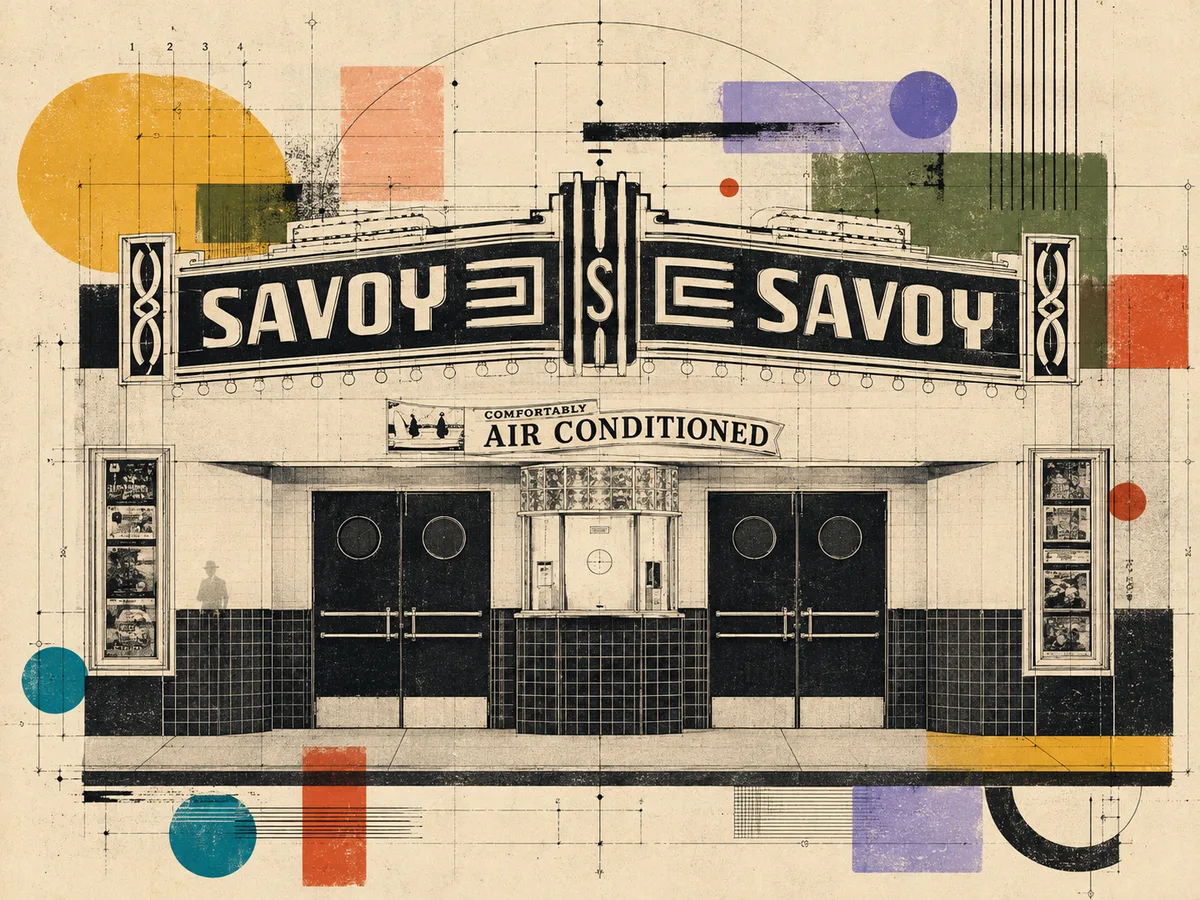
The Mecklenburg Historic Landmarks Commission says five movie theaters were built for African Americans in Charlotte between 1920 and 1960. The Grand is the only one of that group whose historic theater building survives as such. The five appear to have been the Lincoln, Savoy, Grand, Astor and Ritz — the Grand on Beatties Ford Road, the Savoy in Brooklyn. And, good lord, the Savoy was handsome; the illustration above is it.
The Lincoln Theatre, at 408 E. Second Street in Brooklyn, began as the Rex and became the Lincoln in 1933. It presented Black vaudeville as well as films and was later operated by the Bijou Amusement Company. It lasted until 1961. Sources disagree about exactly when the earlier Rex began operating — one says the 1920s, another 1930 — but its 1933 renaming and 1961 closure are well attested.
The Savoy, at 508 S. McDowell, was a roughly 600-seat house and one of the grander Black theaters in Charlotte. It showed films and live acts and got a Streamline Moderne renovation by prominent Charlotte architect Louis Asbury. Former Brooklyn residents remembered it alongside the Lincoln as one of the neighborhood’s two principal theaters. Interestingly, an oral-history interviewee initially calls them Black-owned and then corrects himself: they were not Black-owned, but their managers were Black. That’s a very useful warning against treating “Negro theatre” as synonymous with Black-owned business.
The Grand Theatre, 333 Beatties Ford Road, is particularly important. It opened in 1937 beside Johnson C. Smith University, seated about 500, showed movies from 1 p.m. to 9 p.m. seven days a week, and remained open until 1967. Mecklenburg calls it the county’s only surviving movie theater that served an exclusively African-American clientele under Jim Crow. Unlike theaters that stuck Black patrons upstairs, the Grand was a place in which Black people were simply the audience.
Then came the Astor, in 1948, serving Black North Charlotte. And finally the Ritz, at 1201 Beatties Ford Road, built around the beginning of the 1960s. It appears to have been the last Charlotte cinema constructed specifically for African-American patrons. The Ritz survived into the 1970s before eventually being demolished; its site is now a community space commemorating the theater.
So the Astor wasn’t some weird isolated accommodation. Charlotte had a geographically distributed parallel cinema system.
An oral-history interviewee calls them Black-owned, then corrects himself: they were not Black-owned, but their managers were Black. A useful warning against treating “Negro theatre” as synonymous with Black-owned business.
04Durham gets even more interesting: there was a Black “Movie King”
This may be my favorite thing I found.
Frederick K. Watkins of Durham literally styled himself the “Movie King.” He was a Black entrepreneur who opened an African-American theater in Durham by 1913 and built the Wonderland Theatre at Pettigrew and Ramsey in Hayti in 1920. His theater holdings eventually grew to 16 theaters across North Carolina, South Carolina and Virginia.
The Wonderland wasn’t merely a room showing films. Silent pictures had live musical accompaniment; one remembered pianist, Hattie Shriver Livas, improvised different music for horror scenes, children’s scenes and romances. Watkins also apparently began by exhibiting films in public schools for five cents a child.
And Watkins wasn’t alone.
05North Carolina Black businessmen tried to build an actual theater corporation
This is the rabbit hole I think is genuinely archive-worthy.
In 1926, Watkins joined Samuel H. Vick of Wilson, William S. Scales of Winston-Salem and other Black businessmen to incorporate the First National Negro Theatre Corporation.
And this was not proposed as a mom-and-pop theater company. Its stated business encompassed theater financing, theater operation, vaudeville production, film production, booking services, and standardized theater designs.
Samuel Vick was treasurer; Watkins was president; prominent Durham attorney R. McCants Andrews served as legal adviser. A surviving New York Age report explicitly described the concept as combining Black capital, bankers and theater operators.
That’s remarkable. They were contemplating something resembling a vertically integrated Black entertainment company in North Carolina in 1926.
Vick himself already had experience. His Globe Theatre in Wilson was operating by 1914 on the second floor of the Odd Fellows Hall and is identified by local historian Lisa Henderson as Wilson’s first Black-owned moving-picture theater. It also booked vaudeville.
The corporation seems not to have developed into the national enterprise its founders envisioned — documentation becomes thin, and the Depression probably didn’t help — but the ambition is astonishing.
06Rocky Mount had another surviving Black theater district
Rocky Mount’s Douglas Block was one of the city’s principal Black commercial districts. The Savoy Theatre, later renamed the Booker T. Theatre, was built around 1925–26 at 130 E. Thomas Street, while the nearby Manhattan Theatre appeared by the mid-1930s specifically to serve the African-American community. Both are documented in state historic-preservation records.
The Booker T. is especially neat because Rocky Mount restored it in 2009 and still uses it as a public events venue.
So Charlotte isn’t the only NC city where a segregation-era Black cinema has survived by becoming a modern performance space.
Raleigh’s Lincoln Theatre has essentially the same biography. Built in 1939, it served Black Raleigh residents as a movie theater during segregation and survives today as the Lincoln music venue.
07And Durham shows the two worlds literally across town from one another
The Carolina Theatre in Durham admits in its own historical account that when it opened in 1926, Black patrons used separate entrances, ticket booths, lounges and seating, and had to climb 97 un-air-conditioned stairs to reach the segregated second balcony.
Meanwhile, in Hayti, Black Durham had Watkins’s Wonderland and other theaters where Black people constituted the ordinary audience rather than a population to be architecturally hidden.
That’s one of the important complications in this history: the Black theater arose because of oppression, but it wasn’t merely an inferior imitation forced by oppression. These places became commercial, social and cultural institutions in their own right. They employed Black managers and musicians, hosted vaudeville and touring performers, supported Black business districts and gave patrons an experience fundamentally different from being sent up a side staircase to the worst seats in a white house.
And then integration produced a strange historical irony. Once Black audiences could attend the newer first-run theaters, many dedicated Black neighborhood cinemas lost their captive market. At the same time, urban renewal physically destroyed the neighborhoods containing many of them — Charlotte’s Brooklyn and Durham’s Hayti being glaring examples. The Grand’s official history explicitly attributes its declining attendance partly to newly integrated larger theaters; it closed in 1967.
There’s even a Greensboro chapter that predates the famous sit-ins by more than twenty years: in 1937 A&T students joined Bennett students in protesting movie-theater segregation and the practice of cutting scenes featuring Black actors from films shown in Greensboro. Their boycott failed, but A&T’s own historical account treats it as part of the genealogy of later student activism.